


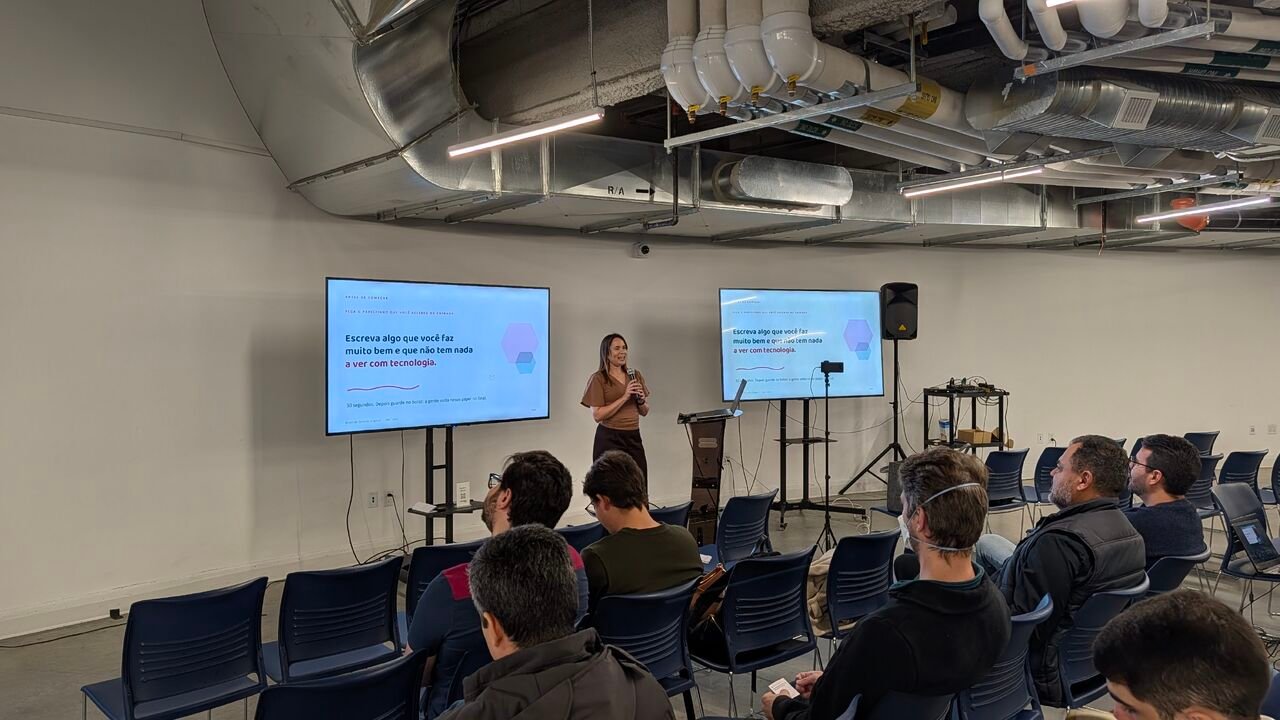
On the evening of October 19th, Calgary BR Tech gathered at the Platform Innovation Centre for “Mudei de Carreira. E agora?” (I Changed Careers. Now What?), presented by Maria Eduarda “Duda” Lyra, a ServiceNow Business Process Consultant and one of the most familiar voices in our WhatsApp group. She opened by admitting she was nervous and promising something light and non-technical. Her goal was modest: if the talk helped even one person in the room, she’d go home happy.
Before Anything Else: A Slip of Paper
Everyone got a small piece of paper at the door. Before the story started, Duda asked the room to take 30 seconds and write down something you do really well that has nothing to do with technology, then put it in a pocket. “We’ll come back to this at the end.”
A Solid Career, on Paper
Duda graduated in Law from UFPE in 2015 and passed the Brazilian bar exam (OAB) on her first try. She spent six years at large law firms in Recife and was halfway through a second postgraduate program. By every outside measure, the career was working.
That was exactly what made it hard to admit something was wrong. As an associate she had no overtime pay, no formal employment contract and no benefits, and she regularly worked weekends and holidays. “It’s ironic,” she said, “law firms are the first to disregard your rights.” The year she was turning 30, she asked herself the question on one of her slides: “Is this the life I want for the next few years?” She saw no room to grow and didn’t feel fulfilled. Later, in the Q&A, she described the clearest warning sign. She was having anxiety attacks, and her heart would start racing as soon as she turned on her computer, before she had even seen what was waiting for her. “If you’re feeling that, it’s not normal.”
Four Months to Turn the Page
Her first step was learning the language of technology. She took a programming course at CESAR, a well-known tech institute in Recife, without knowing where it would lead. She mentioned it on her Instagram close friends list, about 15 friends. One of them worked at KPMG and told her the company ran a program built specifically for people looking for their first job in tech. Duda didn’t quite believe companies did that. She signed up anyway.
The program was free. New hires kept training after they were hired, before they joined a real project, which felt too good to be true. It turned out to be true, and it moved fast:
- July 2022: started the course
- August: finished it in about a month and a half
- September: HR interview, then the technical interview a week later
- October: the offer arrived
- November: first day working in tech
She was careful to add a caveat: this is not a timeline to compare yourself to. Her path was atypical, the market in 2022 was kinder than today’s, and people who went through the same program later have reported much slower feedback. Everyone’s timing is different.
The Part Nobody Sees
The slides covered three costs that rarely make it into transition success stories.
- The fear: “What if that first opportunity never comes?” Learning wasn’t the scary part. Getting in was. In the early months she was lost among data analytics, programming and cybersecurity, and the program gave her a direction.
- The loneliness: Duda doesn’t share big plans until they work out. Only her husband, Emerson, and those 15 friends knew. Not even her parents knew, and her father, also a lawyer, had no idea she was leaving the profession they shared.
- The money: she went from six years into a career to an entry-level role and earned three times less. In exchange she had far less stress and a much better quality of life. “Changing fields has a cost, and it’s better to plan for it than to be caught by surprise.”
This is where the support network came in. Emerson carried the hardest stretch with her, including the financial side. She pointed out that if she hadn’t posted that story about studying programming, the opportunity her friend sent might never have reached her. Her advice: you don’t need to tell everyone, but you need someone.
Where ServiceNow Came In
The KPMG program let participants pick a technology track: ServiceNow, Salesforce or Java. At the time she wanted to be a Product Manager. The Business Analyst role on the ServiceNow track looked closest to that, so she chose it, and admitted she had no idea what ServiceNow was. Java, she added to laughter, was a firm no: “with all due respect.”
She started as a BA with a senior BA training her and has stayed in that role. She never became a programmer and doesn’t want to be. Today she works remotely as a ServiceNow Business Process Consultant for a U.S. company. She designs business processes, gathers requirements and spends a lot of time in meetings. She holds CSA, CIS-ITSM, CIS-DF, PSPO I and PSM I certifications. She would not go back to law “under any circumstances."
"I Didn’t Start From Zero”
This was the heart of the talk. Duda often felt like she was starting over. She wasn’t. Three things came with her from law:
- Breaking the complex into parts. A lawyer takes a complicated case apart to understand it and build a strategy. A BA does the same with a huge business flow. She gave the example of an employee onboarding process at work so large that it’s alarming to look at all at once.
- Writing and documentation. Legal petitions, opinions and contracts demand precision, because every word has consequences. Requirements, user stories and process documentation need the whole team to read them the same way.
- Public speaking. She used to argue a position and persuade the person across the table, including oral arguments in court. Now she runs workshops, aligns stakeholders who disagree and pushes back when a client arrives with fixed ideas about what the platform can do.
In the Q&A she shared a very recent example. A client sent an email questioning deliverables as if her team hadn’t done the work. Her manager asked her to reply briefly. She did. She answered each point precisely, attached screenshots showing exactly when each item had been sent, and her manager praised the reply. “That was so lawyer of me,” she said. A lawyer drafting a brief gathers the evidence, attaches it and argues. She did the same thing.
Paying It Forward: NowGirls
Duda enjoyed the move so much that in March 2024 she and a work colleague co-founded NowGirls. It’s a community of Brazilian women working in ServiceNow, already working with it, or hoping to. The idea is to make the crossing less lonely for the women who come after her. Members share courses, tips and job openings, and some recruiters are in the women-only WhatsApp group (“sorry, guys”). Anyone can follow NowGirls on LinkedIn, and an open meetup for everyone was coming up that same week.
In 2026 the community was recognized inside ServiceNow Brazil. Two people from the company offered to support the initiative, possibly including in-person meetups. NowGirls remains an independent community, not affiliated with ServiceNow.
Back to the Slip of Paper
Duda closed with the three things she’d take with her if she were starting a career change today. Before the list, she asked two volunteers to read their slips of paper.
Emerson went first: cooking. The room helped connect it to tech. Trying a new dish means researching trusted sources, much like debugging. The classic way people learn to think about algorithms is also through a recipe, so following one is already the first step toward writing software. Another attendee had written planning activities. Duda pointed out that planning and time management are essential in every tech role, whether you’re a developer, BA, PO or PM.
Her three takeaways:
- Your baggage comes with you. What you already know isn’t lost. It just changes places.
- The first door is the hardest. Look for programs built for beginners, and accept that you may need to start lower. She took a big pay cut, knowing she was taking two steps back to make a jump soon after.
- Choose carefully who comes along. Even a small support network makes all the difference. If you’re going through a transition, count on this community.
The Q&A: Where to Go, and How to Help
The questions kept coming, and several of them were really about how to start:
- How do you pick a direction? Duda’s push toward IT came from a friend and former colleague, also from law. She had made the jump through a similar entry program at Accenture and seemed genuinely happy. To two former law associates, “a CLT contract and a meal allowance felt like a dream.” Her advice to anyone who doesn’t know where to go is to seek out people who made a transition, in any direction. Someone in the CBRT WhatsApp group went from IT to law. Ask what drove them and how they feel now, then check whether you want the same things. And remember that IT is much more than programming: “I’m terrible with numbers, and it’s still working out.”
- Was it tied to moving countries? No. Moving abroad was Emerson’s dream, and she hoped he’d give up on that “crazy idea.” The career change is what opened the door. While still at KPMG, she was approached by a company in England for her first-ever interview in English. Afterwards Emerson told her: “See? The world is open to you now.”
- How does a partner help without pushing? One attendee asked how to support his wife’s career change without steering her toward his own field. Emerson answered from the other side of it. He made it clear to Duda that he would hold things together at home and she was free to find whatever fit, and he researched options with her instead of choosing for her. Another attendee added that the most useful thing his partner had done was point out strengths he couldn’t see in himself.
The conversation turned to AI, as it often does these days. Anderson shared a feeling many in the room recognized: at some point everyone may need to look around and ask what they know how to do, or are willing to learn, to keep a career going. Fernando offered a hopeful counterpoint from his own move from manager to developer. He enjoys the work most now that he directs AI that writes the code and documentation, much like a pilot who rarely flies by hand but is still in command. One closing thought from the room summed it up: if you start something and find out you don’t like it, you’ve still learned something about yourself, so it’s never wasted time.
How Our Community Benefits
To wrap up the night, Anderson shared a translation of Could Have Been Me, a song from Sing 2: “I want to live better days, never look back and say it could have been me.” He used it to connect our last three talks: the power of community, impostor syndrome, and now career transitions. All three point the same way. Tell someone what you’re attempting, don’t trust the voice that says you can’t, and don’t spend your life wondering whether it could have been you.
That is why Calgary BR Tech exists. Thank you to Platform Calgary for the space, to NeoOmni for sponsoring as our technology partner, and to Social Grid as our media sponsor. A special thank you to Davi of BClouder, a supply chain consultancy with more than two decades of SAP experience, who joined as a surprise sponsor of the night. He reminded everyone that as AI grows, people who understand business and can talk to other people will be in short supply.
Our next session is on November 16th, when Rafael Menezes shares “How We Scaled from Brazil to the World”, and December will bring something a little different from our usual format. Our 2027 call for speakers is open. As the night showed, everyone is an authority on something, so if you have a story to share, reach out through cbrt.ca. Follow Calgary BR Tech on Instagram @cbrt, LinkedIn and YouTube to stay in the loop. This presentation was recorded, watch it here.
▶ Watch the recording
Watch on YouTube →