



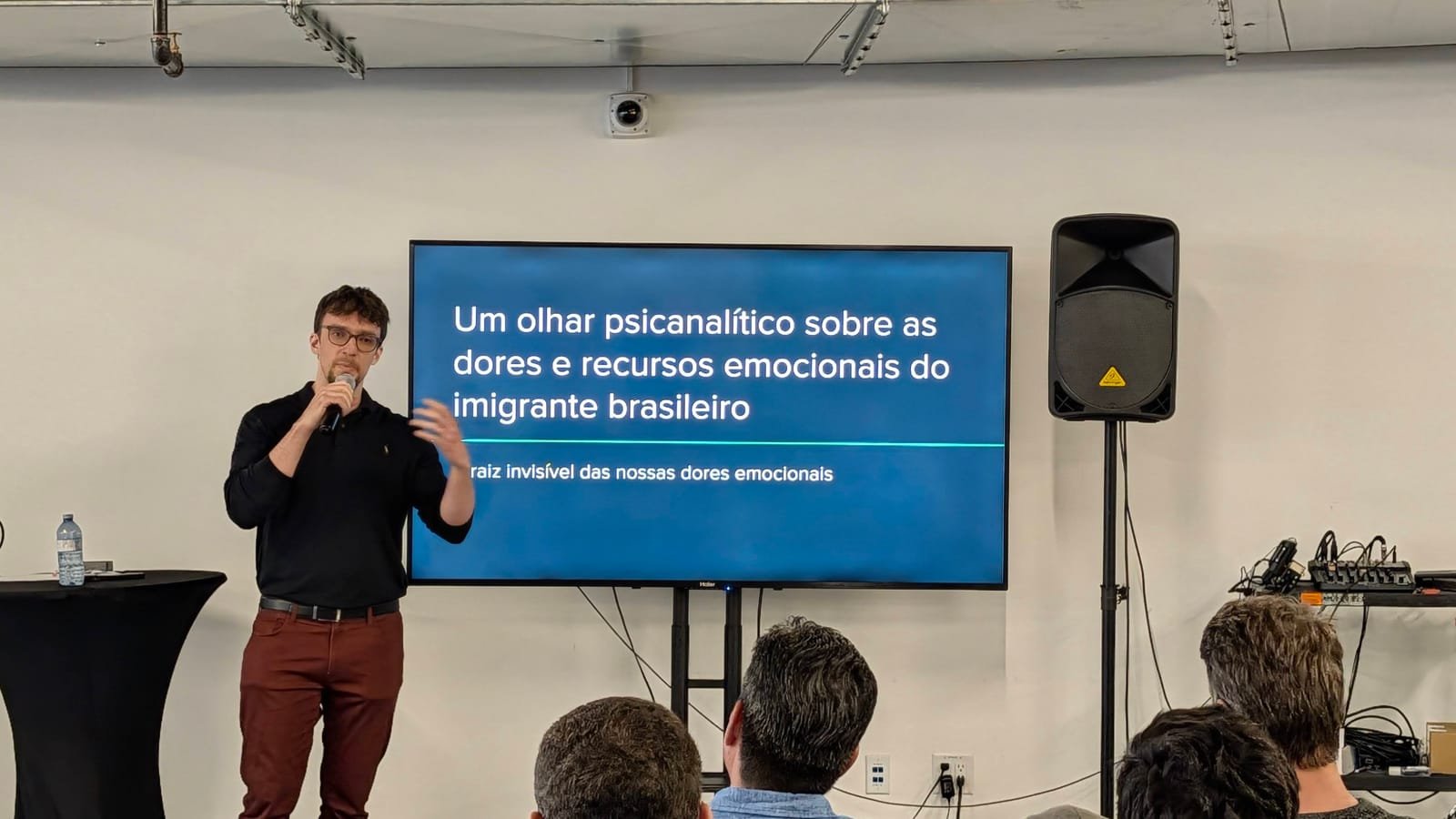
At Calgary BR Tech (CBRT), our mission has always been to support the Brazilian professional community in Calgary, but we know that success in a new country requires more than just technical skills. On April 20, 2026, we gathered at the Platform Innovation Centre for a deeply moving session titled “Dores e Recursos Emocionais do Imigrante” (Emotional Pains and Resources of the Immigrant). Led by psychoanalyst and clinical therapist Leonardo Cordonis, the event provided a safe space to explore the invisible emotional challenges that accompany the immigration journey.
Migratory Grief
One of the most profound concepts Leonardo introduced was “Migratory Grief” (Luto Migratório), which he described as a symbolic death of the identity we held in Brazil. When we move, we lose the external references that sustained our sense of “self” — our favorite bars, our childhood friends, and even the professional status we spent years building.
This loss can create a sense of void and “unbelonging” that is often dismissed as mere adaptation. Leonardo emphasized that recognizing this grief is the first step toward building a new, integrated identity that honors our past while embracing our new life in Canada.
Anxiety vs. Accelerated Thought
The presentation also tackled the common confusion between anxiety and “accelerated thought.” In the fast-paced life of an immigrant, our minds are often in a state of cognitive hyperactivity, jumping from deadlines to future worries without pause.
Leonardo clarified that while anxiety is an emotion signaling a perceived danger, accelerated thought is a pattern caused by excessive stimuli and a lack of mental rest. Understanding this distinction helps us realize that we aren’t always “sick”; sometimes, we are simply overwhelmed by the demands of starting over, and we must give ourselves the “right to rest.”
Loneliness and the “Perfect Immigrant” Myth
Loneliness was another central theme, but Leonardo challenged the idea that it is simply the absence of people. Instead, he defined it as an internal feeling of being “invisible” or “without a place” — especially when language barriers make us feel like a “ghost” in a group.
This feeling is often exacerbated by the “Perfect Immigrant” myth, where we feel a constant need to prove that our choice to move was the right one. We carry a sense of debt to the family we left behind, leading to a “Super Ego” that refuses to let us fail or even complain about the difficulties we face.
The Psychoanalytic Insight on “Lack”
Leonardo introduced a counter-intuitive concept regarding “lack” (falta). A feeling of incompleteness is a structural part of being human and is actually the source of desire, which drives us to move and achieve. Rather than trying to eliminate this feeling of “missing something,” immigrants should make peace with it — recognizing that their “lack” is what motivates their new life in Canada.
The Cure Through Speech and Community
To combat these “invisible pains,” Leonardo highlighted the power of speech and community. The psychoanalytic approach focuses on “curing through speech,” allowing us to organize our internal chaos by putting it into words.
Beyond individual therapy, he encouraged seeking support circles and building new, authentic relationships where we can be vulnerable. True integration requires the proactivity to explore new hobbies and connect with the local culture, even when it feels uncomfortable.
He also announced a new partnership with the Brazilian Association (BCA-AB) to provide therapeutic benefits to its members.
Events like these remind the CBRT community that we are not alone in our struggles. While we are a tech-focused group, a strong support network is the most powerful emotional resource for anyone starting over. Calgary BR Tech plays a crucial role in ensuring that our members are not only technically prepared for the Canadian market but also emotionally resilient.
▶ Watch the recording
Watch on YouTube →