


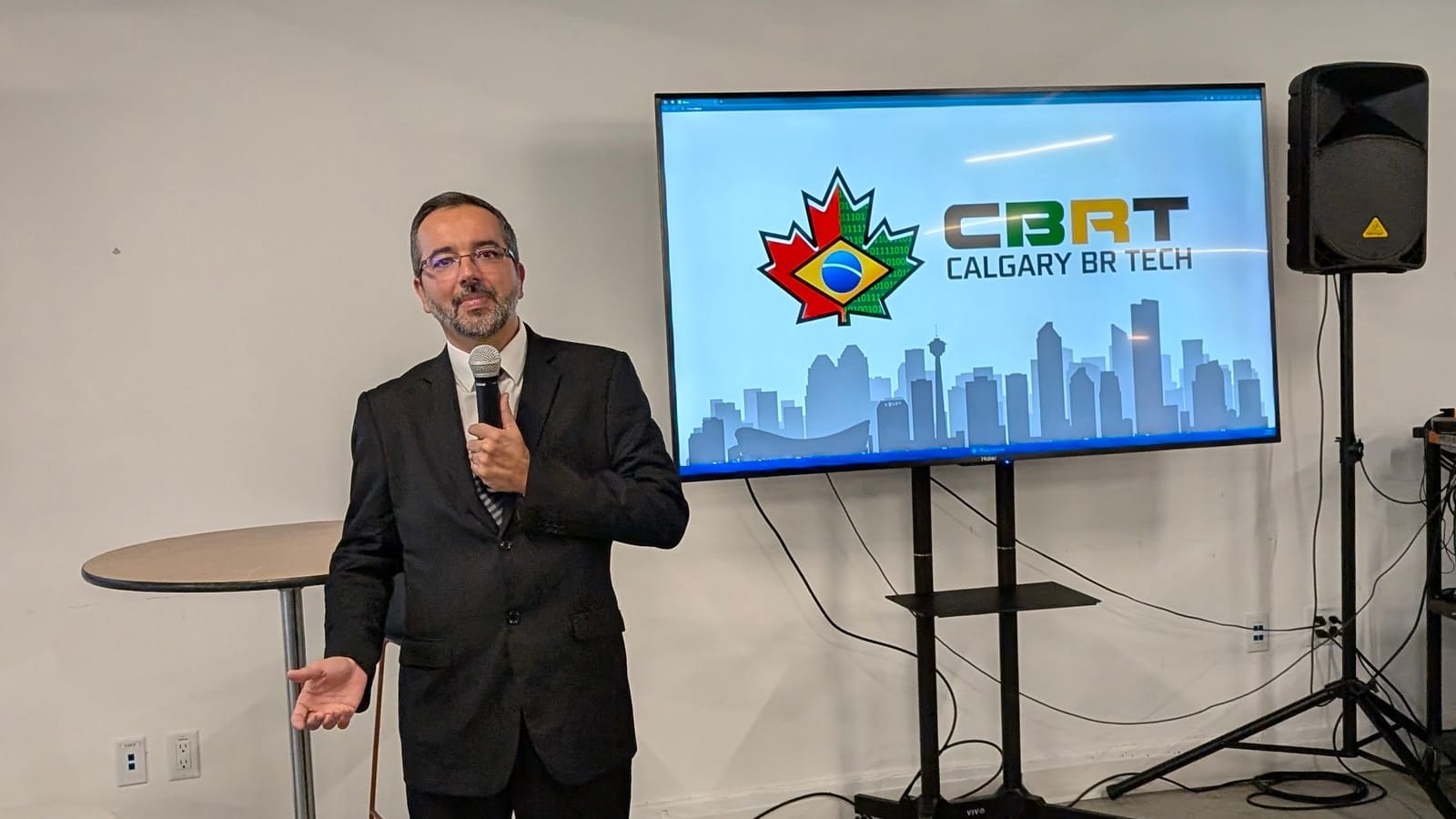
The May edition of Calgary BR Tech brought the community back to the Platform Innovation Centre on May 26th for an inside look at one of tech’s most talked-about roles: DevOps. Our guest was Lelandi Assis, who walked the room, and everyone following the livestream, through what the profession looks like day to day and who is best positioned to get into it.
From LAN parties to four clouds
Lelandi opened with his own story. He started in IT in the early 2000s, back when a weekend meant hauling a heavy CRT monitor to a friend’s place for a Counter-Strike LAN party, and fell for infrastructure after seeing a directory tree on MS-DOS. Since then he has built more than 24 years in the industry, with a degree in IT management, a postgraduate degree in risk management and cybersecurity, and a long track record of keeping systems running for companies of every size.
He then shared a few real projects from his current role, at a company that operates in hundreds of cities across six countries. One was a Discord bot that hands developers anonymized database copies in minutes, a job that used to take a full day of manual work. Another was a set of cloud migrations driven by Terraform, which he said cut infrastructure costs by around 70%.
What it takes
The second half of the talk focused on the career itself. Lelandi described DevOps as a culture of continuous improvement more than a set of tools, and laid out the paths it opens up: site reliability engineering, DevSecOps, platform engineering and cloud architecture. His list of essentials started with Linux, “the base of everything,” followed by networking, Git, some cloud knowledge, tools like Docker, Kubernetes and Terraform, and the soft skills to bridge the gap between development and operations.
His advice for anyone heading that way: practice in labs, share your work publicly, and remember that done is better than perfect.
A lively Q&A
The questions kept coming. One attendee asked whether there is really no such thing as an entry-level DevOps role, and Lelandi agreed: people usually arrive after time in development or operations, because companies need to trust someone before handing over what he called “the keys to the vault.” Others raised security, from credentials left in plain text to exposed configuration files, the impact of Terraform’s licensing change, and how DevOps teams keep a good relationship with developers. A few attendees added their own war stories from banking projects, which turned the session into a real exchange.
The night wrapped up with thanks to Platform Calgary and the usual networking, with plenty of people staying to keep the conversation going with Lelandi in person.
Watch the full recording below.
▶ Watch the recording
Watch on YouTube →