


The October 2025 edition of Calgary BR Tech took place on October 27th at the Platform Innovation Centre, and it opened with some good news before the talk had even started. Platform Calgary had confirmed, just the Friday before, that it would sponsor the community again in 2026, and with that came a bigger change: starting next year, CBRT meetups would move from every two months to every month.
The evening also had a new sponsor in the room. Rodrigo, from Gaia Construction, introduced the company, a residential and commercial finishing business (painting, drywall, flooring, ceilings, facades) that had been operating in Calgary for about a year and a half, and which covered the coffee for the night. Paula, an engineering manager in the Canadian financial sector, also took the microphone to share some giveaways, introduce the colleagues she had brought along and invite anyone curious about opportunities at her company to connect.
Data structures, one classroom at a time
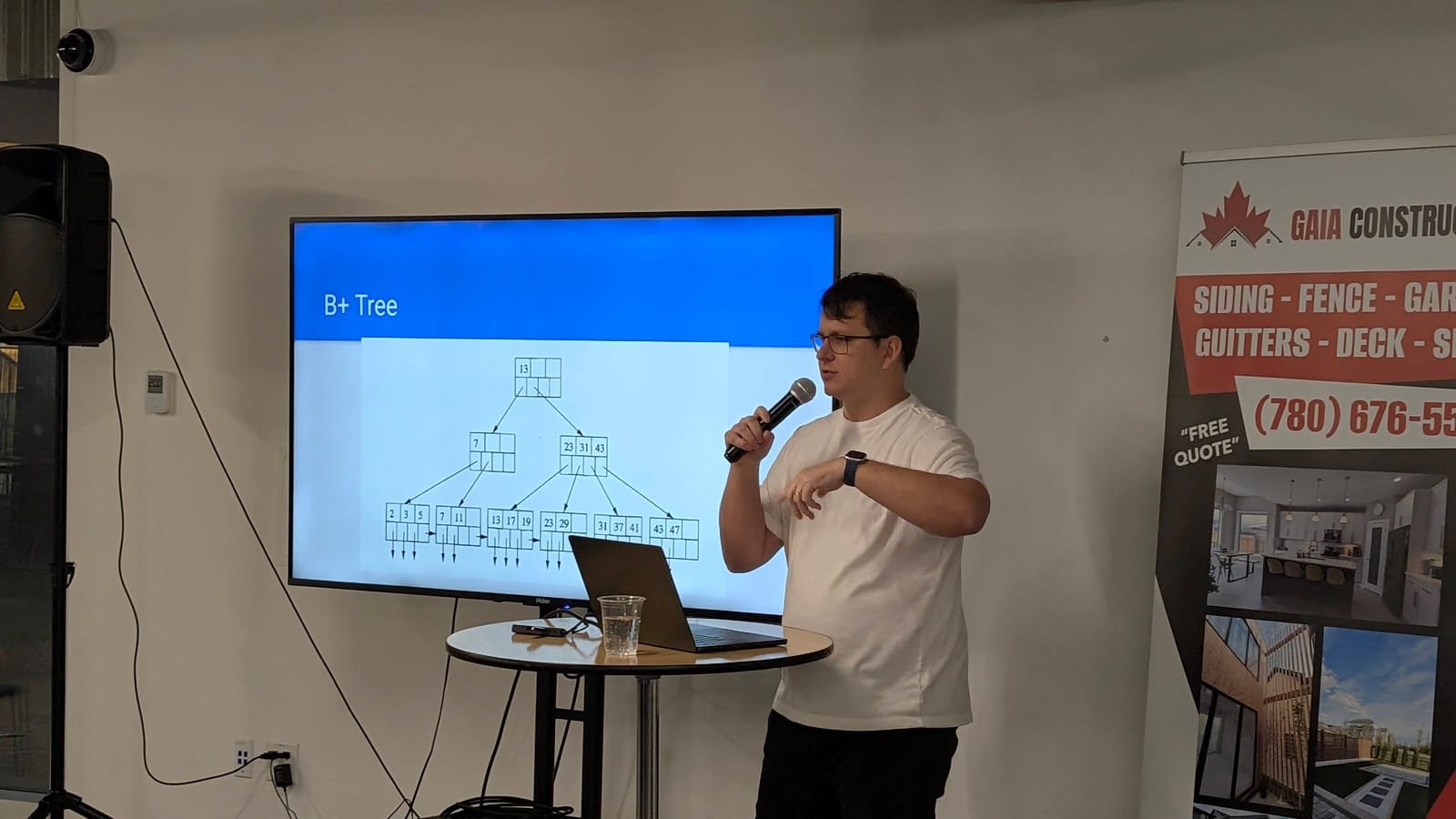
Then it was Pedro Barbiero’s turn. Pedro, a backend developer in Calgary, set himself a clear challenge: explain data structures in a way that people outside tech could follow too.
His device for the whole talk was a school. The computer was the building, each running application a classroom, and every chair an addressable slot in memory. From there, Pedro walked the audience through the essentials:
- Big O notation, illustrated by finding the tallest person in a room of 30;
- Pointers, as pointing at a chair rather than at whoever happens to be sitting in it;
- Arrays, and why most languages start counting at zero;
- Linked lists, hash maps, stacks and queues, each with its own classroom scenario;
- Trees and graphs, including how balanced trees sit behind database indexes, and why reads usually matter more than writes.
The code examples were in C, chosen precisely because it makes memory addresses visible.
Questions, and a few laughs
The Q&A opened with a practical question: which language would he recommend for practicing algorithms? Pedro said C is great for understanding what happens under the hood, but for LeetCode-style practice he’d go with Python for its simple syntax. As for a language he wouldn’t recommend, he told the story of a statistician friend who works in R, where arrays start at one, which got a good laugh from the room.
When the questions slowed down, Pedro joked that his presentation must have been so bad nobody had understood anything. One attendee came to his defence with a comment instead: graphs, the part that had made the room go “now it got complicated”, are really everything that came before combined, and something everyone uses daily, from social connections to the vector relationships behind artificial intelligence.
Networking and an open invitation
To close, Anderson thanked Platform Calgary and Gaia Construction, shared stories of people who found jobs through connections made at CBRT, and invited anyone interested to help organize the community or to claim a speaking slot on the 2026 calendar, which was open from January to December. Then the stream ended and the networking began.
Watch the full recording below.
▶ Watch the recording
Watch on YouTube →