


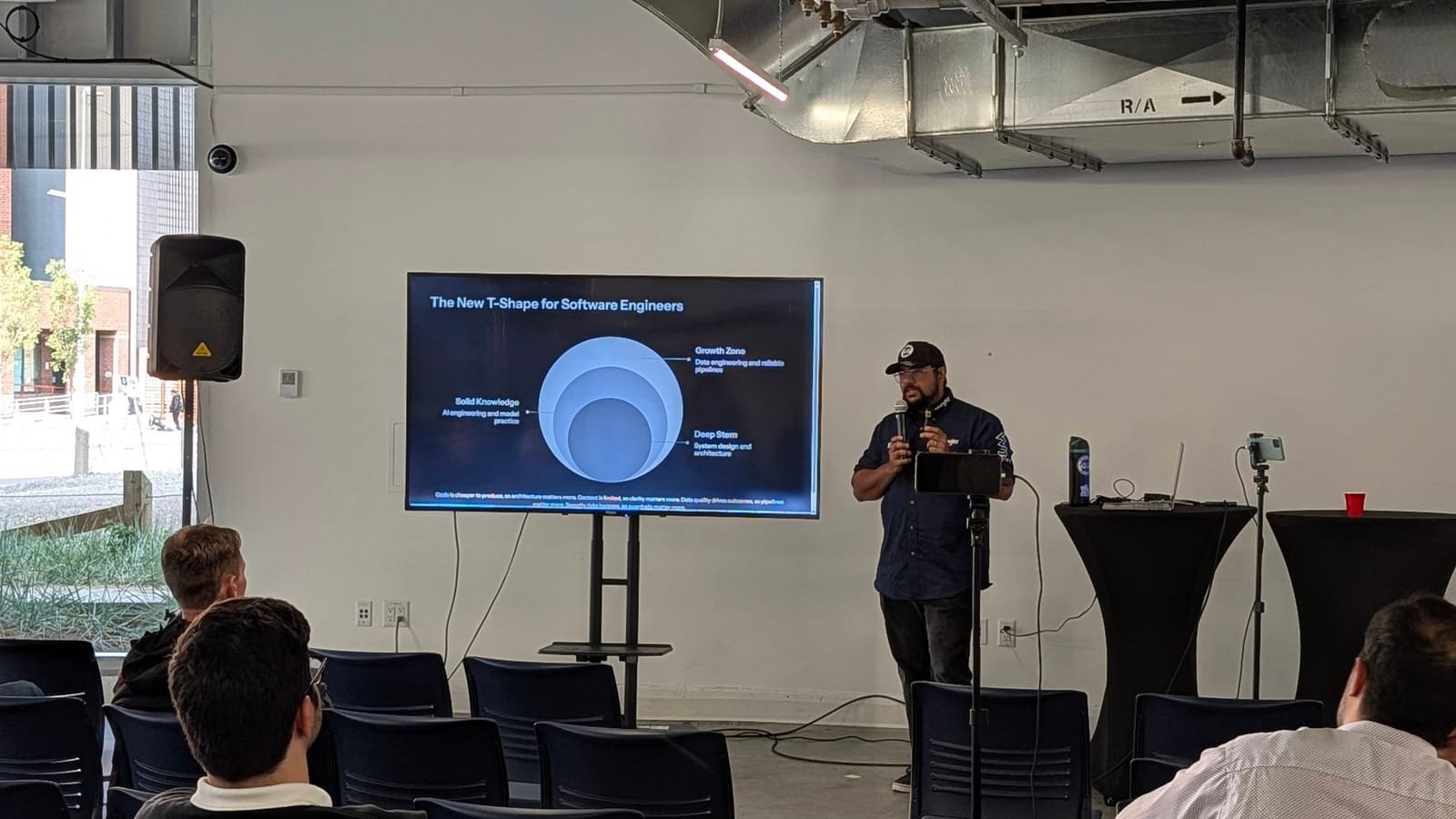
At Calgary BR Tech, we believe that innovation grows faster when people grow together, and our August 2026 meetup was a glowing example of this belief in action. Hosted at our monthly home, the Platform Innovation Centre, we gathered our community of Brazilian tech professionals to explore a topic at the forefront of everyone’s minds: how to navigate our careers in an era dominated by artificial intelligence. Sponsored by our generous partners New Omni and Social Grid, the evening featured a deep-dive presentation by Julio Falbo, a software developer at New Omni, titled “Generalist vs Specialists in AI World”. As a team dedicated to helping Brazilian talent thrive in Calgary’s tech ecosystem, we are excited to share the crucial insights from Julio’s talk and a special community tool showcase that followed.
Julio opened his talk by addressing a classic career dilemma: should tech professionals strive to be generalists or specialists? He warned against falling into the “duck problem”—where like a duck that flies, walks, and swims but does none of them exceptionally well, a pure generalist risks lacking depth. On the other hand, focusing purely on high-level frameworks without understanding the core concepts under the hood (such as learning Spring Boot without truly understanding Java or the JVM) creates what Julio described as the “unskilled and unaware” trap. To balance these two extremes, Julio championed the concept of the T-shaped professional. In this model, you possess deep, specialized knowledge in one core area while maintaining a solid, emerging curiosity in adjacent technologies, allowing you to adapt without losing your competitive edge.
With the massive rise of generative AI, the day-to-day work of software development is undergoing a fundamental shift. Julio emphasized that the value of a developer no longer lies in memorizing syntax or writing code line-by-line, as AI models can generate code instantly. Instead, the modern developer must think like an architect, focusing on software design, project patterns, and system design principles like DRY (Don’t Repeat Yourself) and KISS (Keep It Simple, Stupid). Borrowing from Linus Torvalds’ famous quote, Julio declared that while “talk is cheap,” now “code is cheap” as well. The real differentiator is critical thinking and design—understanding the business logic, asking product managers “why” a feature is needed, and building solutions that deliver the highest return on investment (ROI).
For those looking to orchestrate AI effectively, Julio provided an enlightening look under the hood of how these systems work. He explained that since the release of the Google “Attention Is All You Need” paper in 2017, modern Large Language Models operate on probabilistic next-token prediction rather than deterministic logic. This means that ensuring reliable results requires careful system architecture rather than blind trust. Julio walked the audience through advanced concepts like using the Model Context Protocol (MCP) to securely connect AIs to external tools (like Jira or Confluence), utilizing Retrieval-Augmented Generation (RAG) to share team context, and establishing markdown-based topologies and guard rails to prevent hallucinations. By building a solid architecture around AI, developers can execute complex, reliable tasks without draining their budgets or over-allocating tokens.
The event took an exciting, practical turn when Fernando Horta, a Software Engineer and key member of the Calgary BR Tech team, stepped up to share a tool he built to solve a real-world community pain point: job hunting. After realizing how much time was wasted tailoring resumes and cover letters for over 100 job applications, Fernando decided to use his development skills to automate the process safely. He developed a Python-based, open-source tool that reads a user’s professional background and tailors a custom, ATS-friendly resume and cover letter for specific job descriptions. Crucially, the tool is designed with privacy in mind—ensuring that sensitive personal data (like names, emails, and phone numbers) is never sent to the external AI model. Released under the MIT license, Fernando has shared this repository freely on LinkedIn and GitHub, and it is now hosted directly on our community site, cbrt.ca, for everyone to use.
At its core, events like this August meetup illustrate the unique power of the Calgary BR Tech community. We aren’t just a network for swapping business cards; we are a vibrant support system, a launch pad, and a place where Brazilian IT professionals can feel at home while navigating their careers in Canada. Our members benefit directly from these meetups by gaining access to high-level, practical knowledge, peer mentoring, and a collaborative environment where we actively share open-source tools to help one another succeed. By bringing together brilliant minds like Julio and Fernando, we continue to strengthen the local tech ecosystem and empower our members to adapt and lead in a rapidly shifting market. We invite you to visit cbrt.ca to check out Fernando’s resume tool, and don’t forget to confirm your spot for our next meetup on September 21, where Fernando Horta will return to lead a highly anticipated talk on Impostor Syndrome!
▶ Watch the recording
Watch on YouTube →