



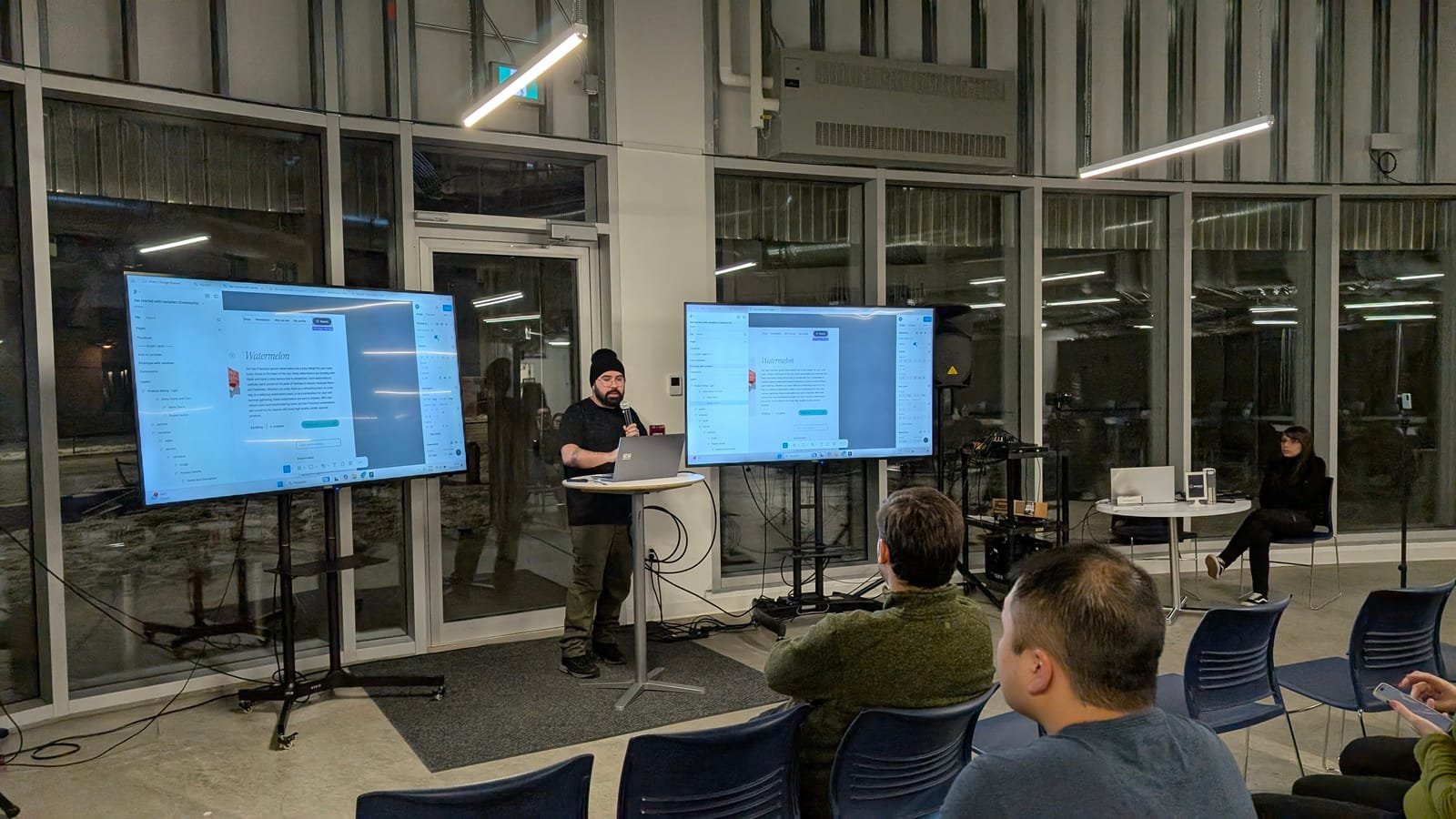
Calgary BR Tech wrapped up 2024 with a double bill at the Platform Innovation Centre on December 19th: one talk for designers, one for developers, and plenty of crossover between the two. The night of the sixth edition of CBRT got off to a bumpy start, with venue access issues pushing everything back and a ventilation system that didn’t want to cooperate, but the show went on, both in the room and on the livestream.
Prototypes That Feel Like the Real Thing
Denys Rocha opened with Figma Variables and Conditionals. Originally from Maceió, Denys has ten years in tech, five of them as a product designer. Before that he was a front-end developer, and he holds a bachelor’s and a master’s in Computer Science. Today he designs for an applicant tracking system, the software recruiters use to screen candidates.
He built a live demo on a grocery store product page, using variables and if/else logic to drop the stock count each time someone added an item to the cart and to hide the item when it sold out. Until recently, he said, that kind of behaviour meant duplicating the same screen over and over. He also covered design tokens and dark mode.
The highlight came from his day job. One prototype was realistic enough to calm a frustrated client who was about to leave. Another put a scorecard feature in the hands of the sales team before it had even been built. In the Q&A, he talked about using prototypes in developer handoffs, and he admitted that people sometimes mistake them for the real product. He takes that as a compliment. He closed by encouraging the developers in the room to give design a try: it’s a learned skill, not a talent you’re born with.
Clean Architecture, No Code Required
Next up was Anderson Oliveira, giving his first talk at CBRT after many evenings behind the scenes, and he admitted to some nerves. He has more than 19 years in software development, starting with VB6 and building his career on .NET. He calls himself a “Clean Architecture evangelist.”
His Clean Architecture 101 was deliberately code-free. He started with a few warnings: Clean Architecture isn’t for every project or every team, it assumes solid knowledge of SOLID principles and design patterns, and there is no silver bullet. In his words, Clean Architecture “is about divide and conquer.” He then walked through layered architecture, microservices and client-server before getting to Uncle Bob’s famous concentric-circle diagram. To explain the layers, he took apart a kitchen food processor: the blades as the domain, the control panel as the application rules, the motor and power as infrastructure.
The Q&A dug into the trade-offs. Anderson named the main costs as verbosity, complexity and a steeper learning curve, especially for less experienced teams. He then shared a recent story: his latest job interview involved explaining Clean Architecture on a whiteboard, as if to a junior developer, instead of solving coding puzzles. He also promised a follow-up talk with real code.
Wrapping Up the Year
The night ran later than usual, so once the last question was answered everyone headed straight for the snacks and networking that close every CBRT evening.
Watch the full recording below to see both talks.
▶ Watch the recording
Watch on YouTube →