



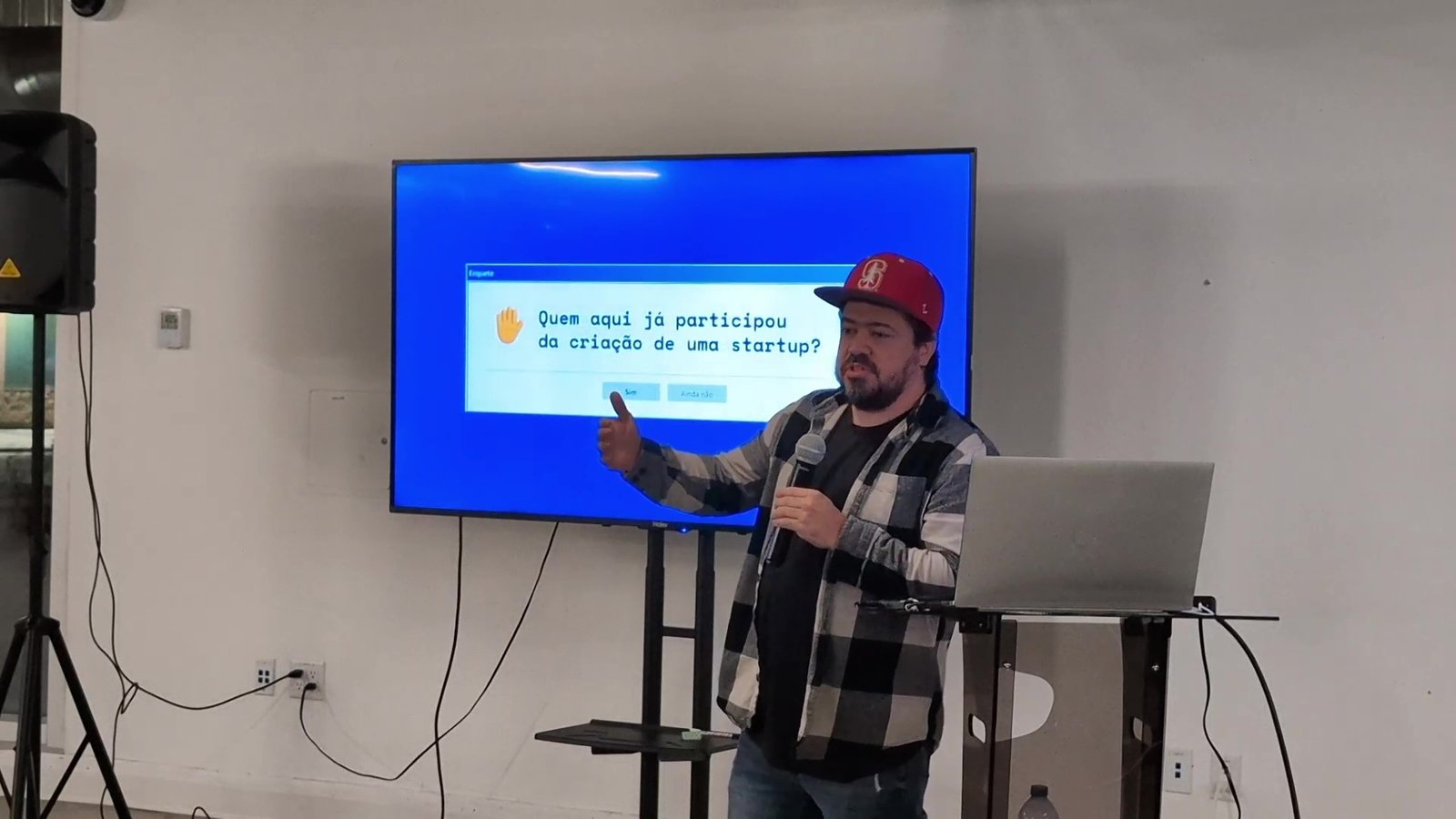
On the evening of November 16th, Calgary BR Tech gathered at the Platform Innovation Centre for “Startup Sem Fronteiras: Como Escalamos do Brasil para o Mundo” (Startup Without Borders: How We Scaled from Brazil to the World), presented by Rafael Menezes, a developer with a little over two decades in the field and a member of the CBRT team. Every slide was dressed up as a late-90s desktop window, complete with error dialogs, install wizards and a Start button. He opened with a quick poll: who has built a side project? Who put it in production? Who got a customer, an employee, an investment round? The hands dropped off fast, and that, he said, is the usual cycle.
The End of the Story, First
Rafael started with the results. The startup he co-founded in Brasília in 2015 went on to serve clients in more than 25 countries on five continents, with over 2 million users in its base and peaks of 300,000 concurrent users. None of it was a plan, he stressed. “It wasn’t even a dream we pictured. It just happened, and I’m going to try to tell you how.”
The Developer Who Didn’t Want to Deal With People
Fresh out of high school in 2000, with no money for university, Rafael knew only one thing about his future: he didn’t like dealing with people, so he would deal with computers. He passed the exam for a two-year technical course in Brasília and dove in. His first internship cured him of that idea quickly. Technology doesn’t exist without the people who use it.
He also argued that developers and business people want the same thing more often than they think. The business person is driven by results and wants to build something big. The developer is driven by the urge to create. Many successful companies are born when the two meet, and that’s exactly what happened to him.
Meet Leo
The other half of the story is Leonardo Valença, a friend Rafael met when he was 18 and Leo was 17. Leo was “born to do business,” the kind of teenager who sometimes wore a suit to high school because he already felt like an account manager. “None of this would have happened without him.”
Their first attempts did not survive:
- bonsnegocios.com (2005): a social network for companies. They wrote a business plan and sketched a prototype, but they were too young and each went their own way. It “was born and died in the business plan.”
- SimpleCRM: Leo, by then an account manager at a large tech company, brought Rafael a pile of spreadsheets the sales team hated. They turned them into a lightweight CRM, and the on-premises version was sold to two large companies. One of them hired Rafael, his first official developer job. The slide’s verdict: right product, wrong business model.
In between, Rafael’s career took a detour worth retelling. An IT support internship at a federal court in Brasília wasn’t renewed, possibly because he plugged a printer into the power adapter of an electric stapler and took down the building’s power panel. “It wasn’t my fault.” Losing that internship, he said, was the best thing that could have happened. Within about a month he landed a job monitoring mainframes at Brazil’s Central Bank, where the idle hours and endless spreadsheets pushed him to start automating things. Those were his first real projects as a developer. His point: your end result is rarely what you intended at the start, but you moved, and moving brought you somewhere.
2015: Trying for Real
Around 2015, Leo was a business director with large government contracts and was tired of corporate sales. He called Rafael with a new idea, savings to invest and a car he was ready to sell. Rafael, who was married with a child and already planning a move to Canada, said yes.
The product was myinfoshare, a private social network for companies with a feed, file drive and collaboration tools. A large Brasília company invested and gave them office space, then pulled out. The rescue came from the FAP DF, the Federal District’s research support fund, which approved them alongside about 30 other startups and paid for their first team. Two years later only three or four of those 30 were still alive. “You have to celebrate the small wins,” Rafael said, “or you’ll give up fast.”
Pivoting Is Not Quitting
myinfoshare had no traction, so they pivoted. The new product, imMail, did one thing: formalize instant messaging at work and replace the WhatsApp groups where companies share passwords and confidential information. Slack and Teams existed, but Rafael wanted something as simple as WhatsApp. “My 70-year-old dad uses WhatsApp with zero training. Put Slack in his hands and see if he gets anywhere.” Fewer features, one clear problem.
When imMail needed video conferencing, the team first built on the Twilio API, which in 2016 meant creating every screen and WebRTC connection from scratch. They switched to an open source project instead. “Your customer doesn’t care about your technology. They care about the value and the problem you solve.”
The same young, excited team wanted microservices everywhere, “for when we hit a billion users.” Rafael’s advice was more modest. Once you’re past the MVP and have real customers, do the minimum that lets you scale later: keep your API stateless, don’t keep WebSocket sessions in memory, put a small Redis in the middle to share them. That’s what imMail had, and it’s why scaling later meant simply adding instances.
Getting On the Plane
Rafael admitted he was never the networking type and is still learning. He still went. In 2017 imMail had its own booth at Collision in New Orleans, with Rafael’s English “not exactly great,” a .com.br domain and a logo made in CorelDRAW. In 2018 a Brasília startup association connected them to a program in which the Indian government helped cover the costs for foreign startups, and they ended up at Soft India in Bangalore. He was surprised by how strong the tech scene there was.
Three years in, though, there was still no real traction. The FAP money had run out, and a second investor had come and gone. “The wives were starting to ask: so, is this thing going to happen or not?”
The Turn: A Plugin for Zimbra
The breakthrough was a side door. Zimbra, a long-standing open source email suite, had messaging and video features inside it that nobody liked, delivered by a third-party plugin whose partnership was fading. Several of imMail’s clients used Zimbra. Zimbra had a module API, so the team built a plugin that put imMail’s messenger in the corner of the inbox and added a button to the calendar that dropped a video link into any meeting.
“Nothing very advanced,” Rafael said. Sometimes the thing that finds your market fit isn’t the cleverest idea you spent years on. They started calling Zimbra resellers around the world and signed the largest one, in India. The customers started coming.
Moving to Canada
Growth brought payroll and AWS bills, and the revenue still wasn’t enough. This is where Rafael asked the room to keep their relationships, even old ones. Leo had a childhood friend he had lost touch with, who had since moved to Edmonton and ran a fundraising advisory firm. They reconnected, and together they closed a round with an investor based largely in Vancouver.
The investor wanted the money to stay in Canada, so in 2019 the company was opened here as the head office, with the Brazilian company as a branch. Rafael was already in Toronto, but his move to Canada had nothing to do with the startup. He had gone back to a regular job because the company couldn’t pay him, and the round closed the same week his three-month probation ended. He looked at his wife one more time and went back full time. It also meant he finally stopped earning in reais while living in Canada, “where you never know what next month will look like.”
Then Zimbra noticed that its biggest partners were all running imMail’s plugin. The relationship became an official technical partnership, and imMail became the messaging and video conferencing solution offered across Zimbra’s base, around 25 million user accounts at the time. Zimbra is small next to Google and Microsoft but strong in Brazil, India, Europe and Africa, markets where companies can’t pay premium prices per mailbox. “There is a huge market beyond the United States.” The partnership sent Rafael and Leo back to India to meet Zimbra’s engineering team in Pune and Mumbai.
Growing Pains
At its peak imMail ran infrastructure on AWS in Brazil, India and the United States, and later in Europe. Moving a region away from India to serve Europe made the Indian clients complain, and vice versa. Cloud credits kept them afloat. They got an initial round of AWS credits, then went through AWS’s Foundational Technical Review, a long validation of architecture, security and best practices that unlocks more credits. Two AWS-certified Brazilian consultants, now living in Sweden, helped them through it. When the AWS credits ran out, Google Cloud offered more, and they migrated.
Then came “the peak of remote work”: 24/7 support, an interface translated into five languages, early-morning meetings with India and afternoon calls with Latin America in a language Rafael doesn’t speak. A Colombian account manager was key to their growth there. Rafael’s tip: if you want to go international, at some point you need someone who speaks the language and knows the culture of the region. The slide summed up his own status: Barber: 404 Not Found.
Ten Years in Five Lessons
- Fail fast, learn faster. Every “failed” project built the next one. Almost no entrepreneur’s first project is the one that works.
- Pivoting is not quitting. myinfoshare became imMail. Same vision, right product.
- The team matters more than the technology. A bad hire can cost you time, money and even legal trouble. That’s why Canadian companies take three months and five interviews to hire.
- Think global from day one. Translating your interface and deploying to multiple regions is easy today. Do the basics early.
- Resilience is the most important skill. Ten years takes patience, consistency and some stubbornness.
He backed up the last one with Michael Jordan’s famous quote about missing more than 9,000 shots and 26 game-winners. “If maybe the greatest basketball player of all time failed that much to get there, who are we not to fail a little?”
The Exit, and Starting Over
In 2026 the ten-year chapter closed: imMail was sold to a Silicon Valley company. The final slides showed Rafael and Leo closing the deal in Palo Alto, at the Golden Gate Bridge and at Stanford, where he bought the cap he wore on stage. “Not because I studied there. I just liked the cap.” He’s now starting again from zero with new ideas, this time with his “life partner” as co-founder.
If You Were Starting Today
Rafael compared what founders have now with what he had in 2015. With AI, you can try fast, fail cheaply, pivot with data and keep searching for product-market fit. You can also build a real project without quitting your job, something he wishes he had done. And you don’t need to be the next unicorn. A startup can be a success without making billions.
So what’s the secret? He asked everyone to turn to the person next to them and ask. His first answer was a photo of a very muscular bodybuilder: broccoli. His real answer was to find your Leo, the business person who complements your technical skills. Events like this one, he said, are where you might meet them. “We don’t have to build alone. Together is more fun.”
He also put together a list of grants, investment programs and cloud credit programs for Alberta and Canada, available at rafmenezes.com/startup.
The Q&A
The organizers asked the first question: was selling always the plan? No. The goal was to build the company and make money with it. “It’s hard to predict the right moment to exit.”
The other questions came from the room:
- Did the language barrier ever make you want to quit? Not the language. Other things did, “at least once a week, in the shower,” depending on the period. Then it would pass, and he would try a little longer. “Do that, and ten years go by.”
- Where is Leo now? In São Paulo. He refused to move to North America because he loves Brazil. He’s back in the tech market, teaches at a business school, gives talks, and for years helped lead the Brasília startup association that opened the door to India.
- How big did the team get, and what was the hardest part? Ten to twelve people at the peak, mostly in Brazil, plus a Canadian account manager in Edmonton and the Colombian account manager in Latin America. The first team, about five people in the same office, “threw sparks,” with fights in every pull request. Nobody, including the two founders, had ever managed people, and the endings were painful. “Managing people in the same space is hard.”
- How did you handle branding? It was pure B2B. They tried paid marketing and got almost nothing from it. What worked was word of mouth, account managers knocking on doors, emails and meetings. “Nobody clicks a Google ad and buys a solution worth thousands for their company.”
How Our Community Benefits
Rafael’s story shows how a community works. A friendship from high school became a company. An old acquaintance in Edmonton brought in the investment round. A startup association led to India, and a group of resellers led to a global partnership. None of it showed up on a schedule. It all came from people who knew people. That is why Calgary BR Tech exists: so the next person in this room can find their Leo, their investor, or simply someone who has been through it before.
Thank you to Platform Calgary for the space, to NeoOmni for sponsoring as our technology partner, and to Social Grid as our media sponsor.
December will be different: no talk, just our Year-End Happy Hour on December 14th at Barrel No. 612 Grill + Bar in East Village. Tickets are $15 and include a drink, and you can get yours here. Our 2027 call for speakers is open, and most of next year’s dates are already on the site. If you have a story to share, reach out through cbrt.ca. Follow Calgary BR Tech on Instagram @cbrt, LinkedIn and YouTube to stay in the loop. This presentation was recorded, watch it here.